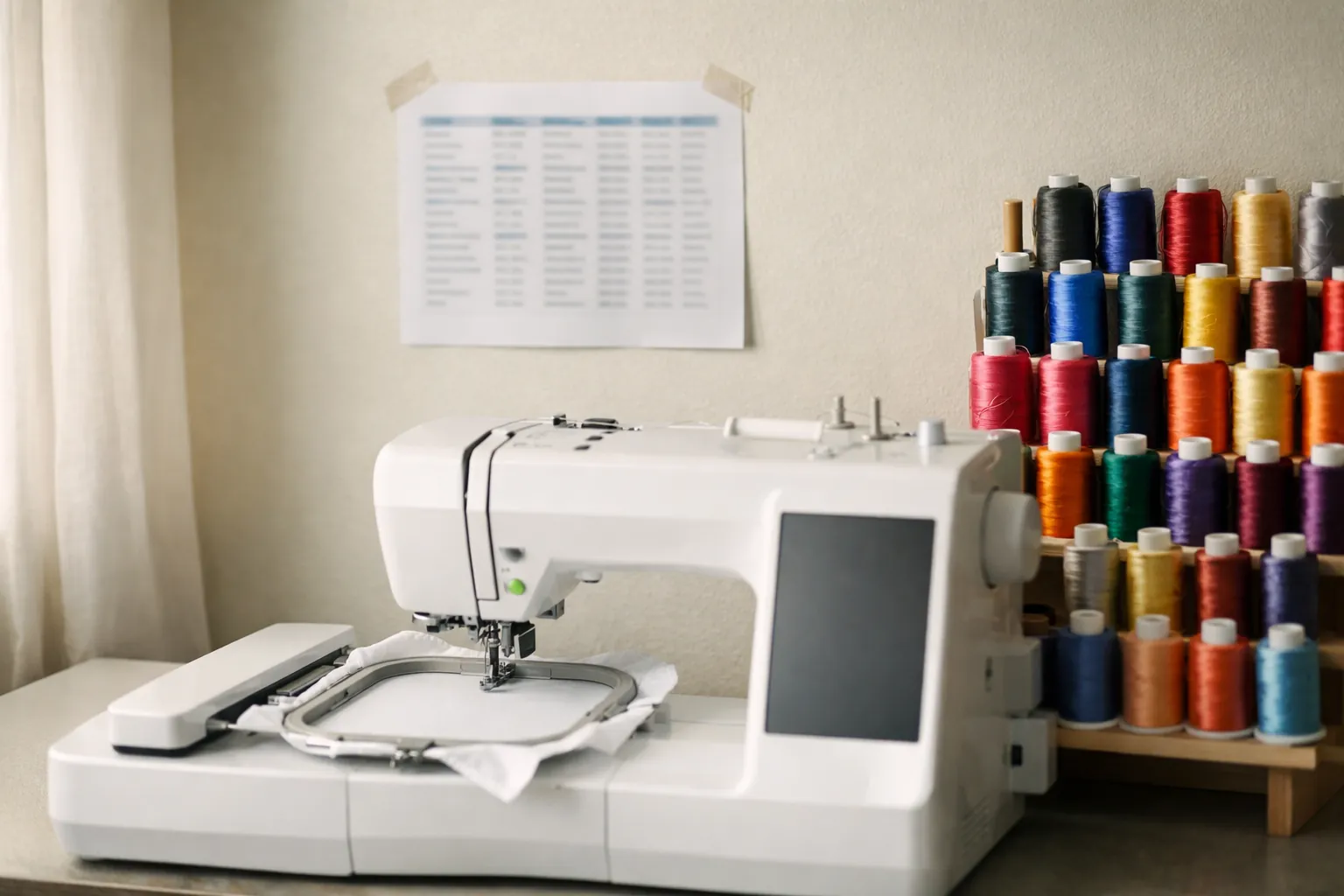
Print the sheet below in landscape and keep it by the machine. Each row takes one fabric and gives you the needle, the backing and whether it needs a topping, plus one hooping tip. Under the table are the thread weights and the three common hoop fields. Placement sizes and a five-point bird's-nest check are there too. Those details usually live in three separate blog posts.
How to use the sheet
Find your fabric in the first column and read across. The needle column assumes 40 wt embroidery thread. Thicker thread or a stack of heavy layers means one size up. The backing column names the stabilizer type and, where the maker gives one, the weight. "Topping" is a layer of water-soluble (or heat-away) film laid on top of the fabric so stitches stay on the surface.
Treat every row as a starting point. Madeira prints the same caution on its own guide: the suggestions aren't a guarantee for every project. Stitch a sample on a scrap of the same fabric before a gift or a paid order.
The cheat sheet
This is the page that prints. On a phone it scrolls sideways. It's set for landscape US letter and prints in black and white without losing anything.
Machine embroidery cheat sheet
Needle, backing and topping by fabric. Assumes 40 wt top thread and a home single-needle machine. Starting points: test on a scrap first.
| Fabric | Needle | Backing (stabilizer) | Topping | Hooping tip |
|---|---|---|---|---|
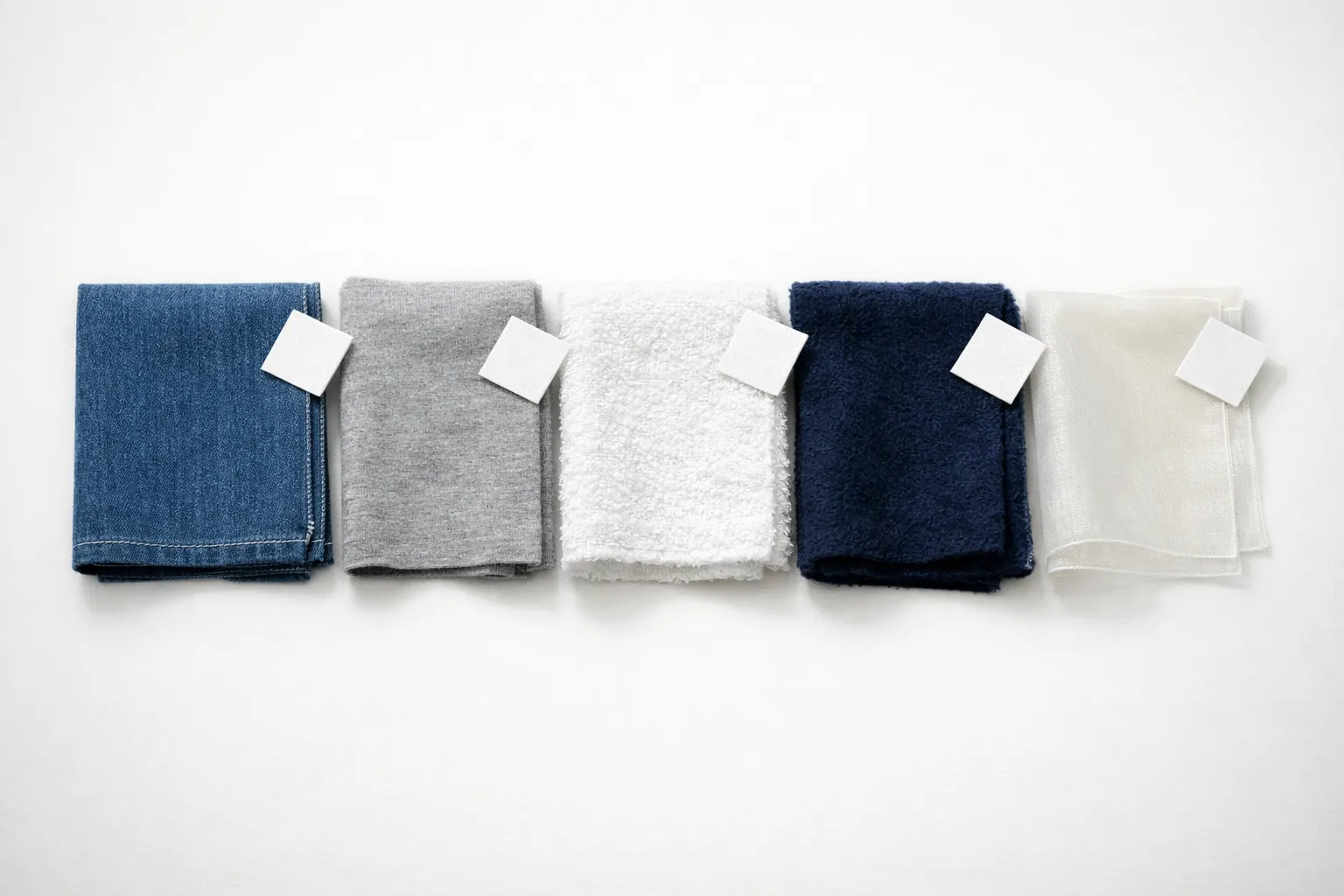
| Quilting cotton, poplin | 75/11 embroidery | Medium tear-away | No | Drum-tight, not stretched |
| Dress shirt, broadcloth | 75/11 sharp | Light no-show cut-away | No | Keep designs small and light |
| Linen-cotton blend | 75/11 sharp | No-show cut-away; soft tear-away if the back shows | No | Small designs suit light fabric |
| Denim, canvas, twill | 75/11 sharp; 90/14 for thick thread | Heavy tear-away | No | Stable fabric: dense designs are fine |
| T-shirt jersey | 75/11 ballpoint | Cut-away matched to the design; no-show mesh on light colors | Optional | Never stretch knit in the hoop |
| Polo pique | 75/11 ballpoint | Medium cut-away, low profile | Yes, water-soluble | Topping stops stitches sinking |
| Performance knit | 75/11 ballpoint | Medium cut-away plus light tear-away | No | Small, low-density designs |
| Sweatshirt, waffle knit | 75/11 ballpoint | Medium to heavy cut-away | Yes, water-soluble | Magnetic hoop or float if too thick |
| Fleece | 75/11 ballpoint | 1 or 2 light no-show cut-away | Yes, water-soluble | Avoid crushing the pile |
| Towel (terry) | 75/11 sharp | Soft tear-away | Yes, water-soluble | Float on hooped backing if bulky |
| Velvet | 75/11 sharp | Soft tear-away | Heat-away | Don't hoop: spray backing, lay on top |
| Faux leather, vinyl | 75/11 sharp | Tear-away | No | Low density; holes are permanent |
| Sheer organza, tulle | 75/11 embroidery | Wash-away | Sometimes | Sticky wash-away for small pieces |
| Free-standing lace | 75/11 embroidery | Fibrous wash-away or heavy film | No | Lace-digitized designs only |
- Top: 40 wt polyester or rayon
- Bobbin: fine embroidery bobbin thread (Brother packs 60 or 90 wt)
- Bobbin type: check your manual
- Shredding or thick thread: go to 80/12 or 90/14
- 4x4 = 100 x 100 mm
- 5x7 = 130 x 180 mm
- 6x10 = 160 x 260 mm
- The design must fit the field, which is smaller than the hoop frame
- Adult left chest: 3 to 4.5 in wide; 7 to 9 in down, 4 to 6 in from center
- Youth left chest: 5 to 7 in down, 3 to 5 in from center
- Tee center back: 5 to 6 in below the neck seam
- Cap front field (Brother PR cap frame): about 5 x 2.4 in
- Rethread the top with the presser foot UP
- Bobbin: right type, right direction, fine bobbin thread
- Fresh 75/11 needle, flat side to the back
- Brush lint from the bobbin area
- Fabric must not bounce: tighter hoop, right backing
Sources: Schmetz needle guide, Madeira backing guide, Hoopmaster placement guides, Brother product pages. Checked Oct 3, 2026.StitchTested · stitchtested.com/machine-embroidery-cheat-sheet/
Where the needle column comes from
Schmetz's needle guide lists its embroidery needle in 75/11 and 90/14, with a light ball point and a wide eye and groove to protect the thread. It carries a red color band. Madeira's article on 75/11 needles splits the choice by point: a ballpoint 75/11 for polos and performance wear (plus lightly woven fabric), and a sharp 75/11 for tightly woven fabric, twill, denim, canvas and caps. Madeira also says to step up to 80/12 or 90/14 with thicker threads.
So the sheet uses one size almost everywhere and changes only the point. That matches the embroidery row in our sewing machine needle sizes chart, which gives 75/11 to 90/14 for embroidery.
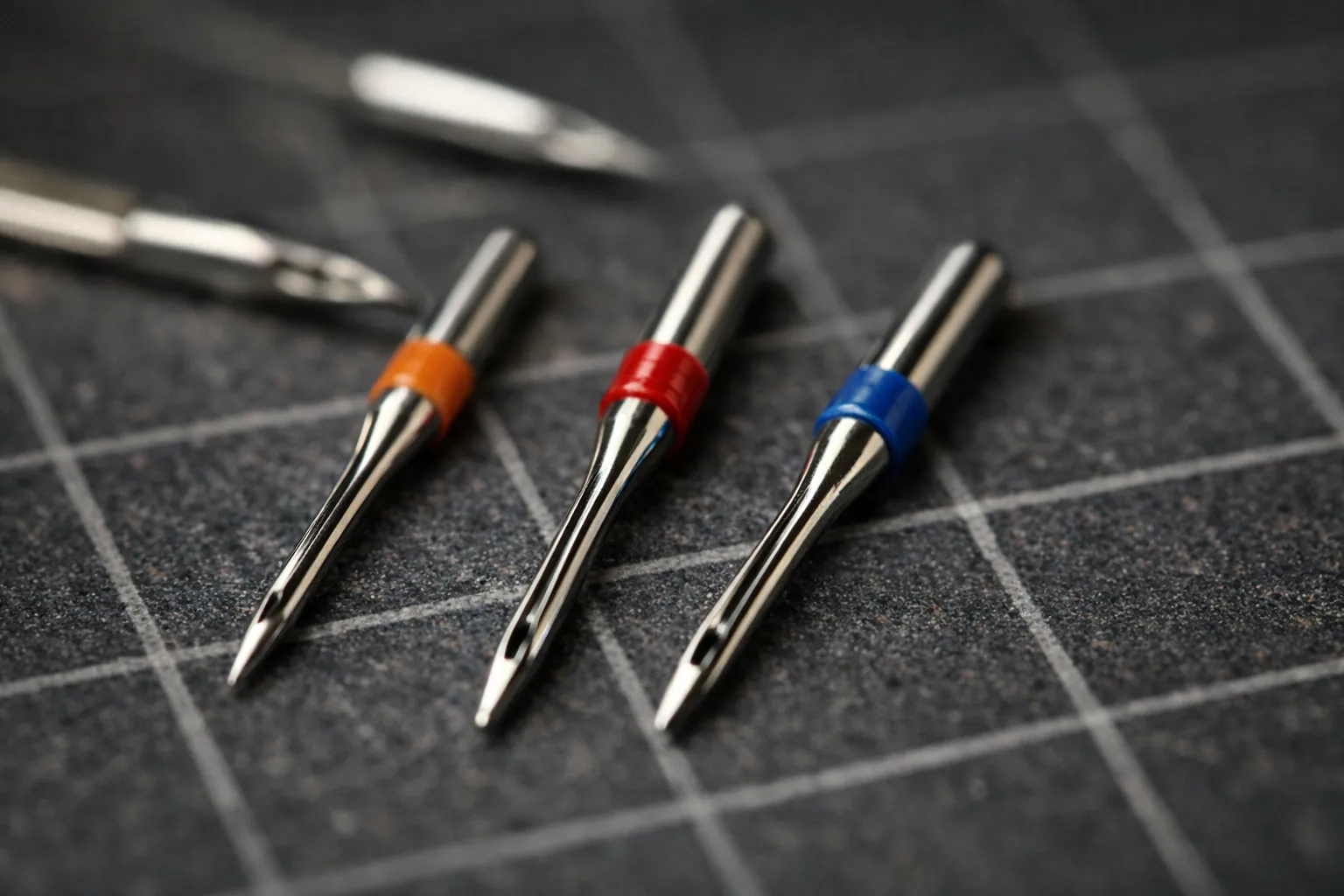
Change the needle more often than you think. Madeira puts the life of a machine embroidery needle at about 8 hours of running time, and a worn one shows up as thread breaks and shredding, or skipped stitches. Brother's own 75/11 embroidery needles (SAEMB7511, 100-pack) come in sets of ten with a flat-back shank, per the listing.
Where the backing column comes from
Most rows come from Madeira's E-Zee backing guide, which goes fabric by fabric. A few examples, close to its own wording: jersey gets a cut-away matched to the design, and pique gets a low-profile medium cut-away plus a water-soluble topping. Terry towels get a soft tear-away and a water-soluble topping. Twill wants a heavy tear-away. On velvet, Madeira suggests spraying adhesive on the backing and laying the fabric on top rather than hooping, because hoop burns are hard to remove.
Madeira also gives the weights it uses. Its basic cut-away runs 1.5 oz (light), 2.0 to 2.5 oz (medium) and 3.0 to 3.1 oz (heavy). Tear-away is lighter at each step: 1.0 oz, then 1.5 oz, then 1.8 to 2.0 oz. Heavier backing is for larger, denser designs.
The sheet agrees with the fabric chart in our embroidery stabilizer guide, which has the long version: why knits need cut-away and how to float an item you can't hoop.
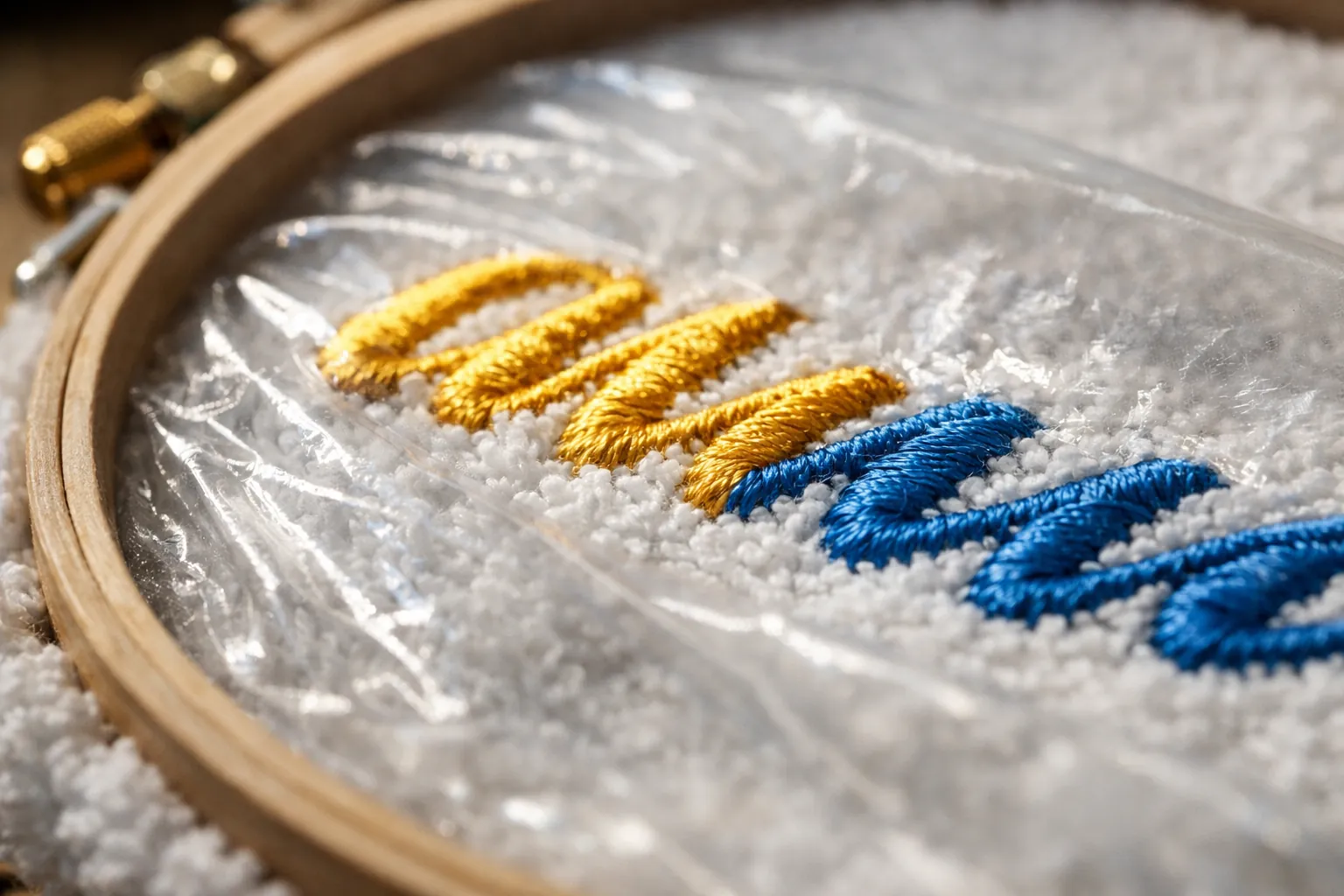
If you're stocking up, these are the best sellers from our October 3 Amazon research: tear-away 8x8 precut sheets (100) for wovens and towels, and no-show mesh 8x8 sheets for light-colored knits.
Thread and bobbin
Top thread is 40 weight. The two biggest thread kits in our research both say so on the listing: the New brothread 40-color polyester kit (40 wt, 500 m spools) and Simthread's 63-color kit. Madeira pairs the 75/11 needle with both its Classic rayon and its Polyneon polyester.
The bobbin takes a much finer thread. Brother's accessory lists show the split: the SE700, SE725 and SE2000 ship with 60 weight white embroidery bobbin thread, while the PE545 and PE900 ship with 90 weight. Brother sells its SA156 bobbin (11.5 mm) as a sewing and embroidery bobbin, in clear 10-packs; check that your manual calls for it before you buy. Your manual is the final word for your model; Brother keeps manuals on its support site.
Placement sizes
There's no official standard for where a logo goes. The sheet uses Hoopmaster's guides, which are written for production shops and list the numbers plainly:
| Placement | Design size | Where it sits | Source |
|---|---|---|---|
| Adult left chest | 3 to 4.5 in wide | 7 to 9 in down from where collar meets shoulder seam, 4 to 6 in from center front | Hoopmaster |
| Youth left chest | Smaller; Hoopmaster uses a 4.25 in hoop | 5 to 7 in down, 3 to 5 in from center | Hoopmaster youth guide |
| Tee center back | Varies | 5 to 6 in below the back neck seam | Hoopmaster |
| Hoodie or jacket back | Varies with style | 7 to 10 in below the back neck seam | Hoopmaster |
| Cap front | About 5 x 2.4 in field | Centered above the bill | Brother PR-series cap frame listing (130 x 60 mm) |
One practical limit for home machines: a 4x4 field fits a left-chest logo, and a 5x7 fits it with room to spare, but neither fits a jacket back in one hooping. Cap fronts need a cap frame, and those are sold for multi-needle machines like Brother's PR series, not for SE or PE models.
Hoop fields
The sheet lists the three sizes most home machines use, in the same millimeter figures as our embroidery hoop sizes guide. Hoopmaster's rule of thumb for its own hoops is a design about 1 inch smaller than the hoop. On a home machine the hard limit is the embroidery field, so a 4x4 design needs a 4x4 field, whatever the plastic frame measures outside.
The bird's-nest box
A wad of thread under the hoop is the most common panic call in embroidery, and the five checks on the sheet cover most of them in the order that fixes them fastest. The full walk-through, with why each one works, is in why your embroidery machine keeps bird nesting. If you're still choosing a machine, our best embroidery machine for beginners guide covers the 4x4 and 5x7 options.
Sources, checked October 3, 2026: Schmetz needle guide; Madeira, E-Zee Backing & Topping guide (PDF) and the basics of 75/11 needles; Hoopmaster, recommended sizes for popular placements and consistent embroidery placement; Brother product pages for the SE700, PE545, PE900 and SE2000. Product details from Amazon listings checked the same day. How we research · Affiliate disclosure