Print the chart below and pin it by the cutting table. It has three things quilters look up again and again: what size the mattress actually is, what size a quilt for it usually is, and how much yardage each size takes. The yardage comes from our quilt binding and backing calculator, so the chart and the calculator always agree.
Quilt size and yardage chart
Sizes in inches. Yardage for 2.5" double-fold binding, 42" quilting cotton (40" usable), a 12" binding overage and 4" of backing beyond the quilt on every side.
A. Mattress sizes
| Mattress | Inches | cm |
|---|---|---|
| Crib (full-size) | 27¼ × 51⅝ min. | 69 × 131 |
| Twin | 38 × 75 | 97 × 191 |
| Twin XL | 38 × 80 | 97 × 203 |
| Full | 54 × 75 | 137 × 191 |
| Queen | 60 × 80 | 152 × 203 |
| King | 76 × 80 | 193 × 203 |
| California king | 72 × 84 | 183 × 213 |
B. Common finished quilt sizes
| Quilt | Planning size | Mattress + 10" to 15" drop |
|---|---|---|
| Crib | 36 × 52 | n/a |
| Throw / lap | 50 × 65 | n/a |
| Twin | 68 × 86 | 58–68 × 85–90 |
| Full | 84 × 90 | 74–84 × 85–90 |
| Queen | 90 × 95 | 80–90 × 90–95 |
| King | 108 × 95 | 96–106 × 90–95 |
| Cal king | 102 × 100 | 92–102 × 94–99 |
No official standard exists. Planning sizes are Missouri Star's; the range is the formula in box C.
C. Size your own quilt
Width = mattress width + 2 × drop · Length = mattress length + drop (+ 10" to 12" to tuck under pillows)
Queen mattress, 12" drop: 60 + 24 = 84 wide; 80 + 12 = 92 long (104 with a 12" pillow tuck).
D. Binding, backing and batting for each planning size
| Quilt | Binding strips | Binding fabric | Backing size | 42" backing (fewest yards) | 108" backing | Batting package* |
|---|---|---|---|---|---|---|
| Crib 36 × 52 | 5 | ⅜ yd | 44 × 60 | 2½ yd, 1 horizontal seam | 1¼ yd | Baby 45 × 60 |
| Throw 50 × 65 | 7 | ½ yd | 58 × 73 | 3¼ yd, 1 horizontal seam | 1¾ yd | Twin 72 × 90 |
| Twin 68 × 86 | 8 | ⅝ yd | 76 × 94 | 5¼ yd, 1 vertical seam | 2¼ yd | Full 90 × 96 |
| Full 84 × 90 | 9 | ⅝ yd | 92 × 98 | 7¾ yd, 2 horizontal seams | 2¾ yd | King 120 × 124 |
| Queen 90 × 95 | 10 | ¾ yd | 98 × 103 | 8¼ yd, 2 horizontal seams | 2¾ yd | King 120 × 124 |
| King 108 × 95 | 11 | ⅞ yd | 116 × 103 | 8¾ yd, 2 vertical seams | 3¼ yd | King 120 × 124 |
| Cal king 102 × 100 | 11 | ⅞ yd | 110 × 108 | 9 yd, 2 vertical seams | Piece it | King 120 × 124 |
*Smallest Warm & Natural package that covers the backing size. 108" backing assumes 104" usable. Yardage rounded up: binding to ⅛ yd, backing to ¼ yd.
Sources: mattresses, Sleep Foundation (crib: 16 CFR 1241.2); planning sizes and backing method, Missouri Star Quilt Co.; binding method, On Point Quilter; batting, The Warm Company. Checked Oct 3, 2026.
How to use the chart
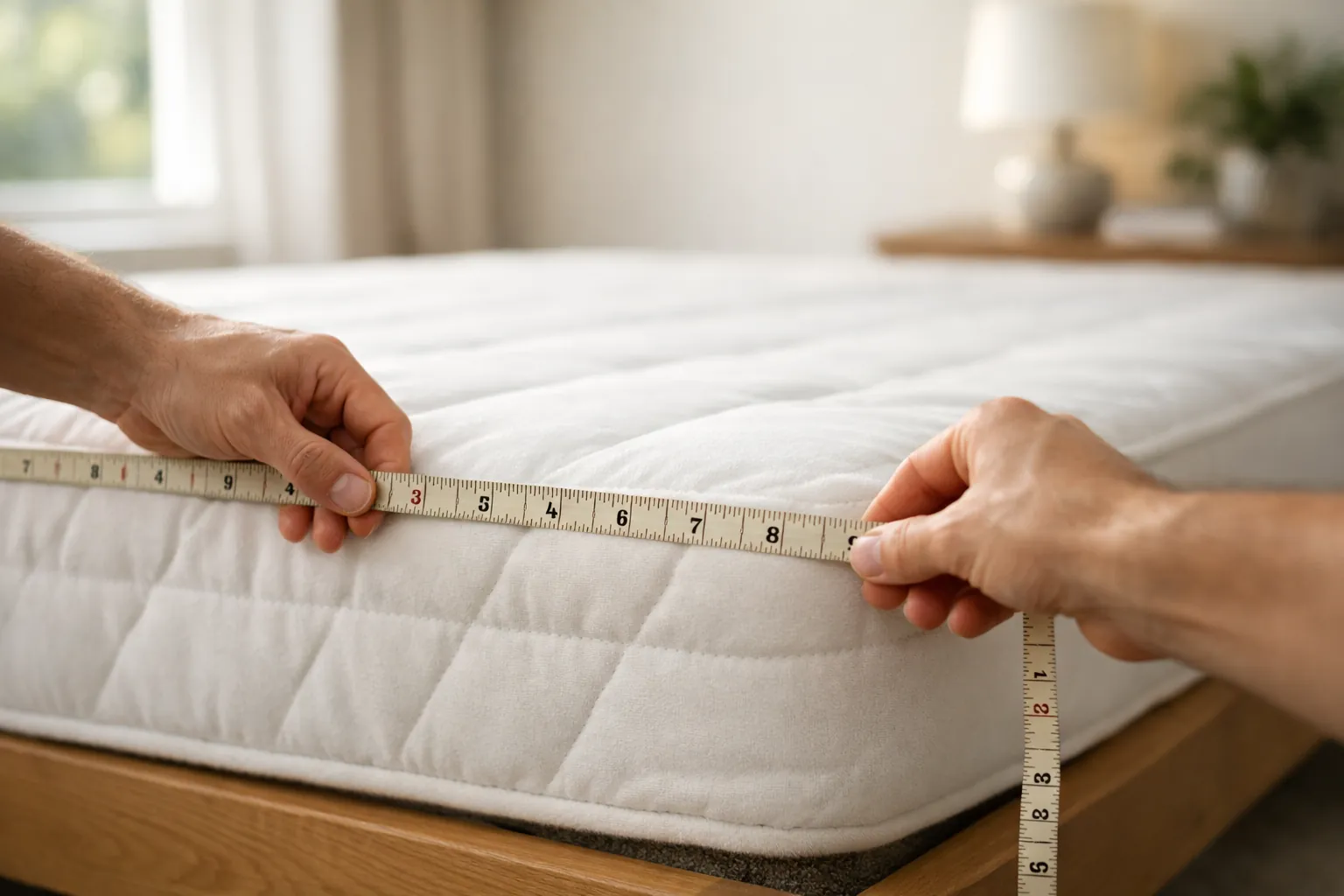
Start with table A if you're making a bed quilt. Measure your own mattress too, because pillow-tops and deep mattresses add several inches of height, and the drop has to cover that. Then pick a drop in box C and work out your own size. The planning sizes in table B are a reasonable default when a pattern only says "queen".
Table D is the shopping list. Find the row nearest your quilt and you have the binding strips to cut, the yardage to buy and the batting package to pick up. If your quilt is a different size, the calculator does the same math for any size up to 130 inches.
Why quilt size charts disagree
There's no governing body for quilt sizes. Mattress sizes are fairly settled (the Sleep Foundation's figures are below), but a "queen quilt" depends on how far the maker wants it to hang. Missouri Star's planning sizes for full and queen (84 × 90 and 90 × 95) are exactly a 15 inch drop on those mattresses. Other charts use 10 or 12 inches and land 10 inches narrower. Neither is wrong.
That's why table B shows two columns. The planning size is a published figure you can match to a pattern. The range is what a 10 to 15 inch drop gives on the actual mattress, so you can see how much room you have to adjust.
Batting is the same story. Packaged batting sizes are set by each manufacturer. We used Warm & Natural's because The Warm Company publishes them on its product pages: craft 34 × 45, baby 45 × 60, twin 72 × 90, full 90 × 96, queen 90 × 108 and king 120 × 124. The batting needs to be as big as the backing, which is why a twin quilt calls for a full package.
How the yardage in table D was worked out
Every number in table D came out of the calculator's code, run with its default settings, not typed from another chart:
- Binding: (2 × (width + length) + 12) ÷ 40 usable inches, rounded up to whole strips; strips × 2.5 inches, rounded up to the next ⅛ yard.
- Backing: the quilt plus 4 inches on every side, pieced in whichever direction uses fewer yards, rounded up to the next ¼ yard.
- 108-inch backing: one cut, using the shorter direction that fits inside 104 usable inches.
As a check, the vertical-seam backing figures match Missouri Star's own chart for all seven sizes (3½, 4¼, 5¼, 8¼, 8¾, 8¾ and 9 yards). Where we list fewer yards, it's because seaming the other direction saves fabric. For the crib, a single horizontal seam takes 2½ yards against 3½.
The binding strip counts assume 2.5 inch strips. For 2.25 inch strips and other widths, see how much binding for a quilt, which has both widths side by side.
Planning the rest of the quilt
The chart covers everything except the quilt top, which depends on your pattern and can't be charted by size alone; how much fabric for a quilt shows how to estimate it from the block count. If you're still choosing a machine for the quilting itself, our quilting machine picks sort machines by the size of quilt you plan to make.
Sources, checked October 3, 2026: Sleep Foundation, "Mattress Sizes 101" (twin to California king); 16 CFR 1241.2 (full-size crib mattress at least 27¼ × 51⅝ inches); Missouri Star Quilt Co. backing guide and chart (planning sizes, backing method); On Point Quilter (binding method); The Warm Company, Warm & Natural packaged sizes. Centimetres are converted at 2.54 and rounded. How we research · Affiliate disclosure